Think & Discuss
Quick Check
Inquiry Task
We must first establish what was normal in the foraging era: whether their diet was more balanced and varied, whether working hours were shorter, what their health and living conditions were like, how broad their range of knowledge and skills was, and whether private property and class in the later sense existed. Only with this baseline in place can we judge which features after agriculture were entirely new inventions and which were transformations of ancient legacies—thereby avoiding the teleology of inferring causes from later outcomes.
Archaeological evidence is direct but fragmentary, biased toward surviving artifacts and burials, and prone to overgeneralization; analogies from modern foragers are vivid and concrete, but those people live in environments different from those of the distant past and have already been influenced by surrounding societies; evolutionary psychology inferences can provide an explanatory framework for the body and preferences, yet they can only offer hypotheses and are difficult to verify directly. A sound approach is to cross-check the three types of materials: treat analogies and inferences as sources of hypotheses, treat archaeological evidence as constraints, clearly label what is fact and what is interpretation, and acknowledge that on some questions there is a "silence of the evidence."
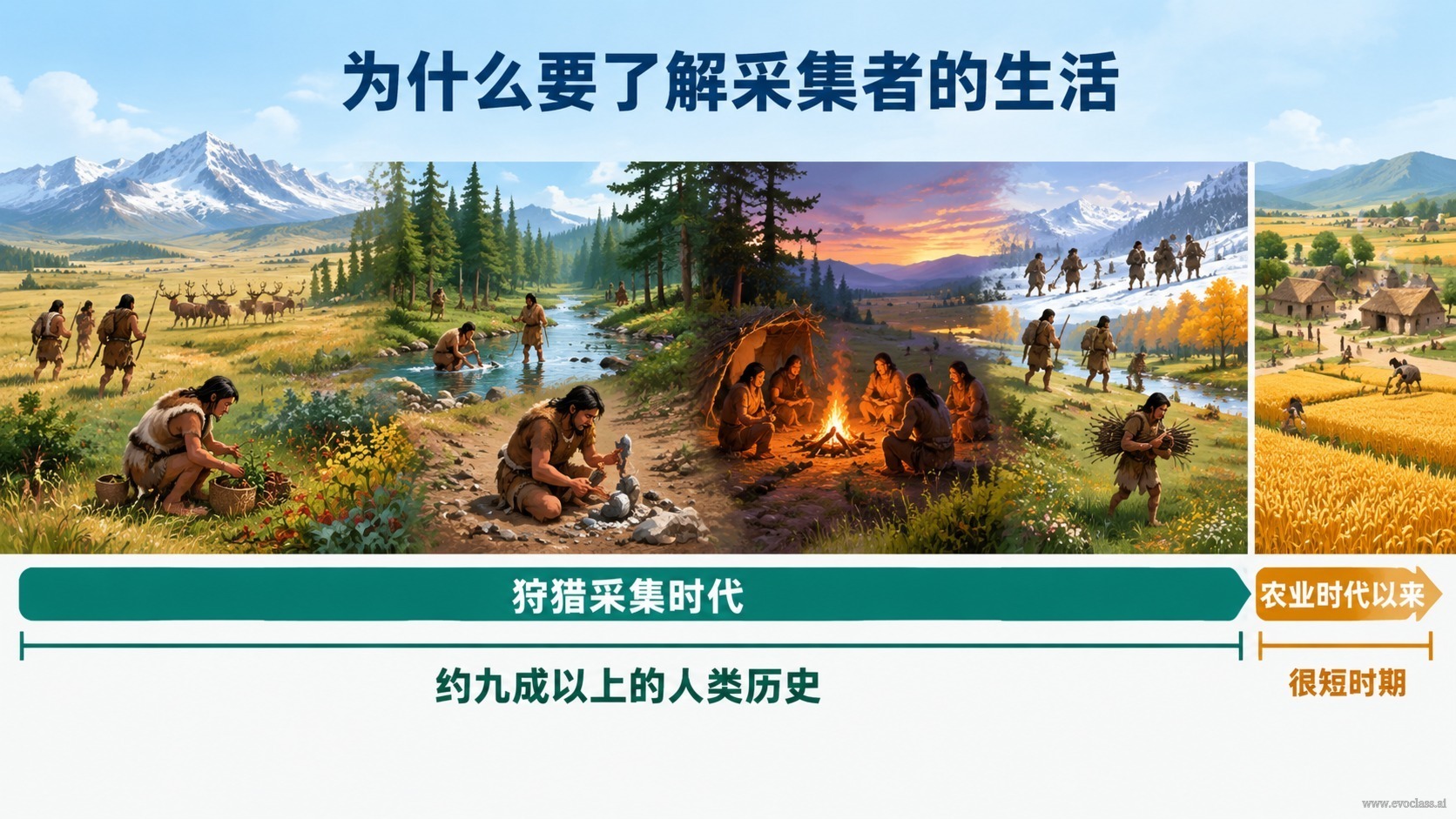
Before the Agricultural Revolution,all Homo sapienslived in hunter-gatherer societies. This way of life lasted about 300,000 years, whereas agriculture has existed for only about 10,000 years. Measured against the entire span of human history, agricultural societies are in factthe exception, not the norm.
Therefore, the lives of foragers are not a "prelude" or "marginal chapter" of human history, but the formative period of the biological and culturaldefault settingsof Homo sapiens. To understand human nature, social structure, and the course of history, we must treat this period—which accounts for more than ninety percent of human history—as the baseline against which all subsequent changes are measured.
The bodies and minds of modern humans remain primarily adapted to the environment of the foraging era, yet we live in an agricultural–industrial–information society. This misalignment between our "design specifications" and the present environment is calledevolutionary mismatch. Evolutionary psychology starts precisely from this point to explain many of the predicaments of modern humans.
Take a common example: the strong human preference for sugar and fat was an advantageous adaptation in a foraging environment where food was scarce and high-calorie sources were rare; but in an industrial society with an excess of sugar and fat, the same preference is associated with obesity, diabetes, and metabolic diseases. The body is still designed for savannas and forests, while life unfolds in convenience stores and on food-delivery apps—a perfect miniature of "the ancient brain trapped in the modern world."
A caveat is in order: this kind of explanation is an inference. When tracing modern preferences back to ancient environments, the evidence is often indirect, and one cannot simply attribute any given modern behavior to "genetic determinism."
To use this baseline to determine which institutions—agriculture, empire, money, religion, the state, and so on—are entirely new inventions and which are transformations of ancient legacies, we must first know what was "normal" in the foraging era. Research suggests that foragers were not necessarily impoverished, ignorant, "primitive" people living hand to mouth: their diet may have been more balanced and varied, their working hours shorter, their range of knowledge and skills broader, their dwellings shifting with the seasons and resources, and private property and class in the later sense may not have existed. These counterintuitive findings undermine the linear teleology of "agriculture equals progress."
But foraging societies left no written records, so reconstructing their lives can rely only on three types of materials, each with its own limitations: archaeological evidence, analogies from modern foragers, and evolutionary psychology inferences. Acknowledging the "silence of the evidence" is a necessary precondition for using this baseline.
| Debate | One View | Another View |
|---|---|---|
| Ancient Social Structure | There existed "ancient commune"-style group sharing and fluid groupings | Based on monogamous nuclear families as the fundamental unit |
| Propensity for Violence | Conflict between groups dates back far into the past; violence was not uncommon | Group size was small and boundaries fluid; the extent of violence may have been exaggerated by later generations |
Related to these debates are beliefs and burials. Animism (the belief that all things have spirits) holds that all things—animals, plants, objects, places—possess spirituality and the possibility of communication, and that the boundary between human and non-human is not sharply drawn. Burials at sites such as Sungir, with their grave goods and ornaments, show that individuals may have held different statuses and roles in life—archaeological evidence that thus offers clues to social and political norms. However, how much a single burial site can really tell us remains a matter of scholarly disagreement, and any citation should make clear that this is an interpretation, not a settled conclusion.
Why We Should Understand the Lives of ForagersStudy the timeline comparison in the image: the hunter-gatherer era (over ninety percent of human history) versus the brief period since the agricultural era. Think about how it relates to the statement "before the Agricultural Revolution, all humans lived in hunter-gatherer societies."